01
Why agents worked
- The term agent gave people a way into AI.
- It made abstract technology feel tangible.
- People need imagination before architecture.
- An assistant, helper, or digital colleague is easier to understand than models, APIs, embeddings, or orchestration.

02
The Bond illusion
- A lot of early AI enthusiasm had a James Bond imagination.
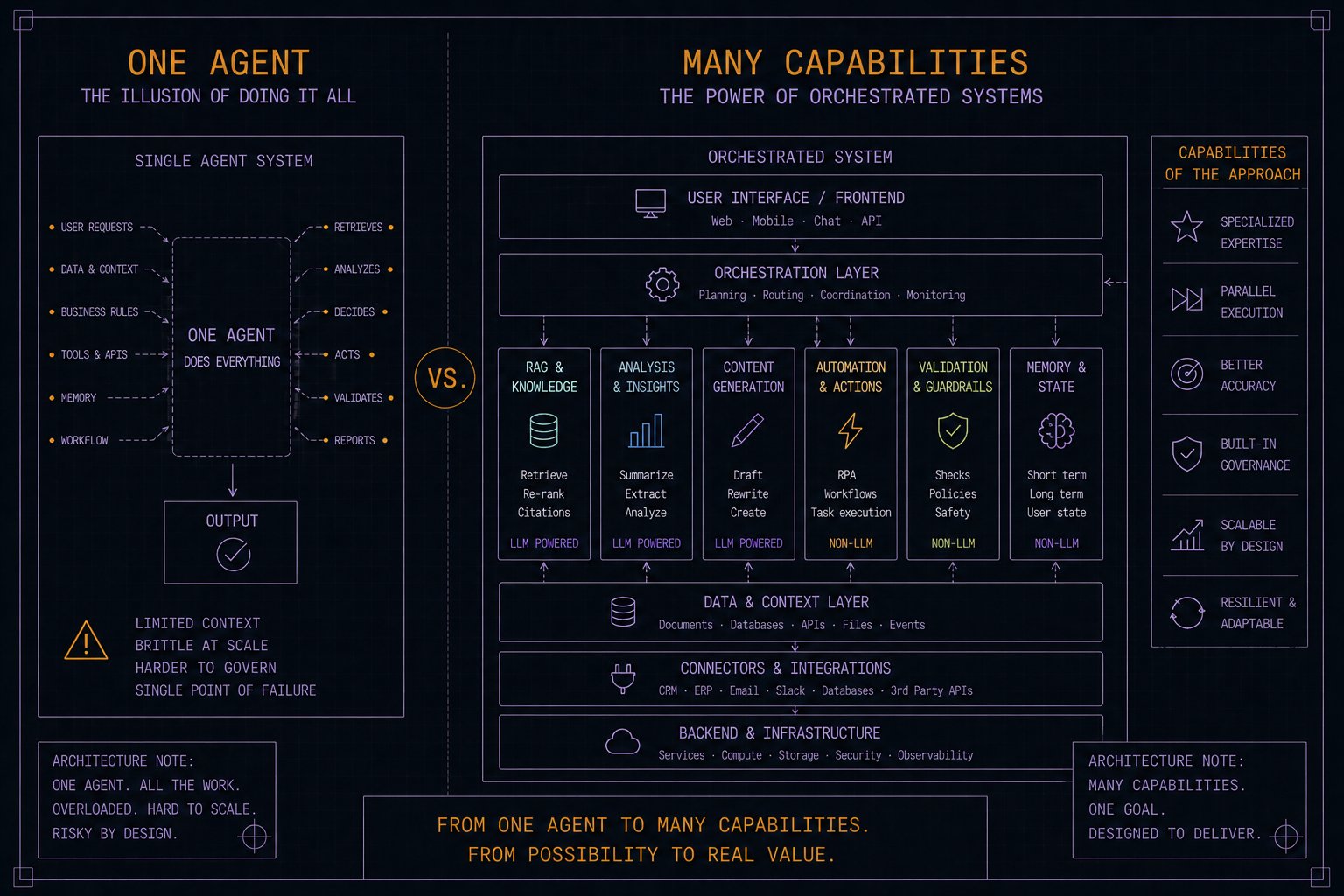
- One brilliant agent at the center.
- Fast, smart, elegant, able to handle everything.
- Useful as a story, but misleading as an architecture.
03
Why Ocean's Eleven is better
- The more real the use case gets, the less it looks like a person.
- Real systems combine different strengths.
- One component retrieves. One analyzes. One validates. One acts. A human may approve.
- The magic is not one genius. The magic is coordination.
04
The chatbot trap
- If every AI idea is framed as an agent, many teams end up building chatbots.
- Sometimes that is useful.
- But often the real opportunity is not another interface.
- It is redesigning a workflow, removing friction, or embedding intelligence into a process.
Reality check
Does my problem need an agent?
Pressure-test your use case before you build it.
Use with ChatGPT, Claude, Copilot, or your internal LLM
Hype filter
Translate idea into reality
Strip the AI framing and find the actual problem underneath.
Use with ChatGPT, Claude, Copilot, or your internal LLM
05
What this means for adoption
- Agents are an adoption doorway, not always the final architecture.
- They reduce fear and help people start.
- But once people understand the basics, the framing should mature.
- From: who is the assistant?
To : what capability is missing? - From: can it chat?
To : can it create reliable value?
06
Practical design questions
- → What workflow are we trying to improve?
- → Which capability is missing?
- → Which part should be language reasoning?
- → Which part should be automation?
- → Which data is needed?
- → Where do humans need to approve?
- → What needs to be monitored?
- → Where does governance matter?